
Text-to-Speech Technology
Turn Your Data Into Decisions. Your Decisions Into Growth.
In today’s digital economy, data is everywhere — but insight is rare.
Every click, transaction, customer interaction, and operational metric holds hidden patterns. The companies that win are not the ones with the most data — they’re the ones who can predict what happens next.
That’s where we come in.
What is Text-to-Speech Technology?
Turn Text Into Natural, Human-Like Voice Experiences
Words are powerful.
But voice makes them unforgettable.
From virtual assistants to e-learning platforms, from customer service bots to accessibility tools — voice technology is transforming how businesses connect with users.
What if your applications, platforms, or devices could speak clearly, naturally, and intelligently?
That’s the power of Text-to-Speech (TTS) technology.
And we help you bring it to life.
What is Text-to-Speech Technology?
Text-to-Speech (TTS) is an AI-powered technology that converts written text into realistic spoken audio.
Modern TTS systems use deep learning to generate voices that sound natural — not robotic.
Major technology leaders like Google integrate TTS into smart assistants and accessibility tools.
Virtual assistants from Amazon use advanced speech synthesis to power voice interactions.
Today’s speech systems can:
Adjust tone and pacing
Support multiple languages
Reflect different accents
Deliver expressive and natural speech
Voice is no longer a feature — it’s a user expectation.
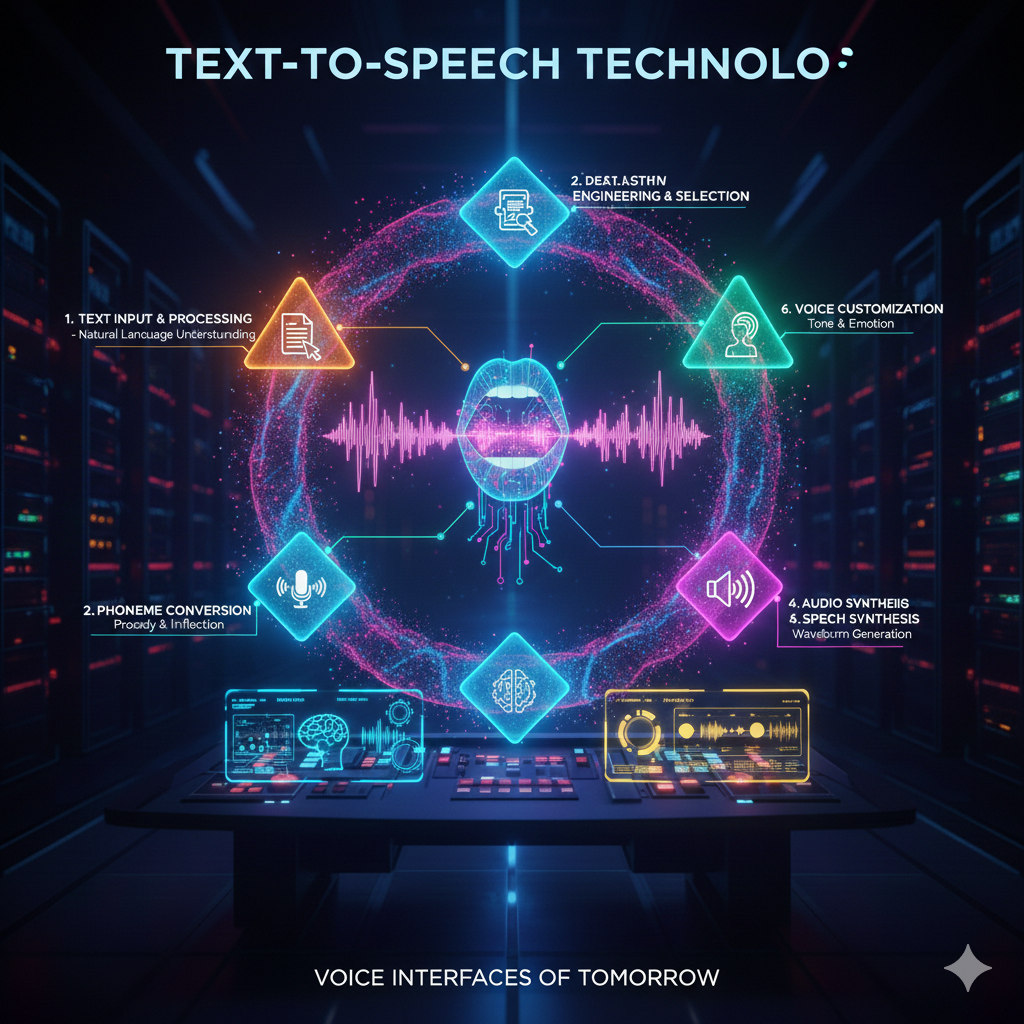
How Text-to-Speech Works
Behind every natural-sounding voice is sophisticated AI.
Here’s how we build high-quality TTS solutions:
🔹 Text Processing
The system analyzes input text, identifies sentence structure, punctuation, and context.
🔹 Linguistic Modeling
AI models determine pronunciation, intonation, and rhythm.
🔹 Neural Voice Synthesis
Deep learning networks generate realistic speech waveforms.
🔹 Audio Output Optimization
We refine clarity, tone, and pacing for the intended audience and platform.
The result?
Smooth, lifelike voice output that enhances user experience.
Real-World Applications of Text-to-Speech
Text-to-Speech technology is reshaping multiple industries:
1. Virtual Assistants & Chatbots
Enable conversational AI with voice interaction.
2. E-Learning Platforms
Convert course material into engaging audio lessons.
3. Accessibility Solutions
Support visually impaired users with spoken content.
4. Customer Support Automation
Provide automated voice responses with natural flow.
5. Media & Content Creation
Generate narration for videos, podcasts, and presentations.
Platforms like Apple integrate advanced speech synthesis into accessibility tools.
Services from Microsoft power enterprise-grade voice solutions.
Voice technology enhances engagement, accessibility, and automation — all at once.
Benefits of Text-to-Speech for Your Business
Implementing TTS delivers measurable advantages:
✅ Enhanced User Experience
Voice interaction feels intuitive and modern.
✅ Increased Accessibility
Make your platform inclusive for all users.
✅ Scalable Content Production
Generate audio instantly without hiring voice talent for every update.
✅ Cost Efficiency
Automate voice responses and reduce operational overhead.
✅ Multilingual Reach
Expand globally with support for multiple languages and accents.
Voice creates connection — and connection drives growth.
Why Choose Our Text-to-Speech Services?
Technology alone doesn’t create impact. Strategy and execution do.
Here’s why businesses partner with us:
1. Custom Voice Solutions
We tailor speech models to your brand tone, audience, and use case.
2. Natural & Expressive AI Voices
Our solutions prioritize clarity, realism, and emotional tone.
3. Seamless Integration
We integrate TTS into your apps, websites, customer systems, or devices smoothly.
4. Scalable Infrastructure
Deploy on cloud, on-premise, or edge environments.
5. Ongoing Optimization & Support
We continuously improve voice quality and performance as your platform evolves.